The Forgotten Soldier by Charlie Connelly
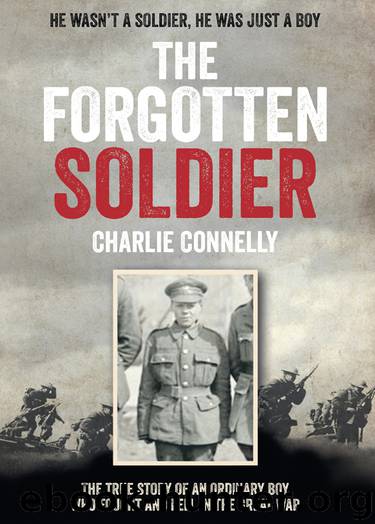
Author:Charlie Connelly
Language: eng
Format: epub
Publisher: HarperCollins Publishers
Published: 2014-10-08T04:00:00+00:00
15
‘We used to sit in the corner of the trench and think about it: we’d say, all this going on, is it worth it?’
When Edward arrived at Poperinge in early April 1918 what sort of conditions would he have found? The war had been raging for almost four years by that stage so the Western Front would have presented a landscape of uninterrupted mass destruction. Trenches would have snaked through the shell-battered battlefield, barely a tree would have stood higher than a blasted stump and most of the towns and villages would have been flattened or, at best, badly damaged. He would have arrived to join a battalion that was exhausted, in shock from the intensity of the German onslaught and trying to come to terms with losing nearly two thirds of their complement in the futile attempts to hold the Germans at bay. In April 1918 there was the very real sense that the Allies were on the point of losing the war. Morale wasn’t exactly at its highest.
‘That was the worst time,’ said William Dann. ‘You couldn’t get it any worse, I should think, beyond earthquakes and volcanic eruptions. We used to sit in the corner of the trench and think about it; we’d say, all this going on, is it worth it? I used to think if I ever get out of this lot I shall be damned lucky. A lot of them were a little bit religious and you’d ask, “If there’s a God about, why the hell doesn’t he stop all this?” A lot of that went on amongst the men: why’s it carrying on? What’s it worth? Nobody really spoke up in favour of the war. You’d just go up and out, up and out, front line and back, front line and back, and got on with it. I never heard people discussing why the war started; we just knew we had to stick at it or stop there altogether.’
‘Conditions were very bad,’ according to Victor Fagence, now recovered from his wounds and back at the Front with a greater respect for his own mortality. ‘All the shell holes filled with water and mud. You couldn’t march over the mud. They made plank roads to a further distance, then duckboard tracks. It wasn’t a very nice thing going up to the front line. All the way up you were liable to come under shell fire at any moment. The Germans knew the ground; it had been fought over for so long they knew the ranges of all the spots. They had their observation balloons and aircraft and knew exactly where the tracks were, and so you’d always come under shell fire. It was so bad that there were cases of men drowning in shell holes if they slipped off the duckboards with their packs on. When you reached the Front there were no trenches any more, just shell holes made into defences, about fifty yards apart. From there the German lines were a couple of hundred yards away, so they were very primitive living conditions.
Download
This site does not store any files on its server. We only index and link to content provided by other sites. Please contact the content providers to delete copyright contents if any and email us, we'll remove relevant links or contents immediately.
| Africa | Americas |
| Arctic & Antarctica | Asia |
| Australia & Oceania | Europe |
| Middle East | Russia |
| United States | World |
| Ancient Civilizations | Military |
| Historical Study & Educational Resources |
Room 212 by Kate Stewart(5180)
The Crown by Robert Lacey(4861)
Endurance: Shackleton's Incredible Voyage by Alfred Lansing(4842)
The Iron Duke by The Iron Duke(4404)
The Rape of Nanking by Iris Chang(4255)
Joan of Arc by Mary Gordon(4155)
Say Nothing by Patrick Radden Keefe(4042)
Killing England by Bill O'Reilly(4041)
I'll Give You the Sun by Jandy Nelson(3494)
Shadow of Night by Deborah Harkness(3407)
Hitler's Monsters by Eric Kurlander(3382)
Mary, Queen of Scots, and the Murder of Lord Darnley by Alison Weir(3240)
Blood and Sand by Alex Von Tunzelmann(3237)
Eleanor & Park by Rainbow Rowell(3232)
Darkest Hour by Anthony McCarten(3161)
Margaret Thatcher: The Autobiography by Thatcher Margaret(3113)
Book of Life by Deborah Harkness(2982)
Red Famine: Stalin's War on Ukraine by Anne Applebaum(2968)
The One Memory of Flora Banks by Emily Barr(2895)
